

Branches of Philosophy (in javascript)

I have a bit more time at the moment to do some reading and so I find myself knotted up with different types of philosophy. Given humankind has had a long time to think, they seem to have created a field of inordinate complexity – in order to get my arms around it, I decided to generate a map of the landscape. Someone has probably done this and taken months or years to do it, and when they finished (like painting the Sydney Harbour Bridge) they would have to go back again and add the new bits.
So I chatted with my old friend Claude and generated a list, plugged it into a mindmapping tool “mindmeister” and it looked pretty good, but it wasn’t interactive. So I prevailed upon Claude to help me map the world of Philosophy in a D3 tree. Click the “Result” tab below and see the tree, you can click on the nodes to expand an collapse. I’ll probably update the input data as its very preliminary (171 different areas).
Observations:
- doing a tree is a bit silly because there is much overlap and competing viewpoints.
- I had to move Neo Platonism around a few different places – no place is perfect for many things.
- I’m not sure when something is just a set of ideas and when it is a philosophy. Plato (or perhaps in Socrate’s voice) defined it as “love of wisdom”. Implicit in this is openness and curiosity, not necessarily staking out some ground to have a new “…ism”. Of course “Prismism” is the meta-meta of them 🙂
- You can’t just ask Claude for a complete list. I needed to prompt it many times with specific fields to get them added, for example: the Kyoto School is in there but currently we don’t have individuals like Hegel, Heidegger, Loch etc. They may be a proponent of a branch of philosophy but they are NOT “a philosophy”.
- Embedding religion in is problematic – but hey…..
- Marxism is widely acknowledged as a philosophy but perhaps some other politics does not qualify. i.e “Green”, “Nuclear Disarmament”, “Fishers and Shooters”
Ethics and Virtues
A trope I hear from time-to-time is that at the base of all religions is a common truth. It goes something like….`everything just “is” – (maaan)` a sort of secular Neo Advaita and a tad lazy. You may get it with your morning coffee from your yin/yang tattooed barista.
In attempting to say something meaningful we get nothing and is akin to pan-psychism, a cool philosophical view that (naturally) also has many detractors. But pan-psychism is more useful as its been cooked up by clever philosophers. (Spinoza, North Whitehead, Chalmers etc).
But with no small amount of irony, I’ve had a lasting curiosity (further up the religious stack) of: what are the ethical commonalities across religions or beliefs?
Most religions have a set of commandments, rules, precepts, guidelines, signposts as to what makes a decent member of society. Back in the bad old days, we had no separation of Church and state so the moral/ethical codes were embedded into the religion.
[[Aside: Unfortunately, such a healthy structure is under fervent attack in western societies now.]]
In western secular society, ethics seem to be “precepts for atheists” and have found their way into schools as an alternative/antidote to religious studies. But really ethics and virtues have existed in religions because the religion serves the exoteric society first before (some) of the flock enter the more esoteric or mystical paths of the belief system. It gets problematic when the religious mystics and powerful behave as if ethics are below their station and history has plenty of evidence to support its pernicious effects over naive acolytes and children.
Ethics, precepts, virtues have a lot of just good healthy humanity at their core. Christopher Hitchen argued that the planet didn’t need organised religion because humanity seemed to get along fine before religions took over, so there must have been strong ethical codes embedded into cultures.
So with my friend Claude, I set out to make tables of good humanity attributes.
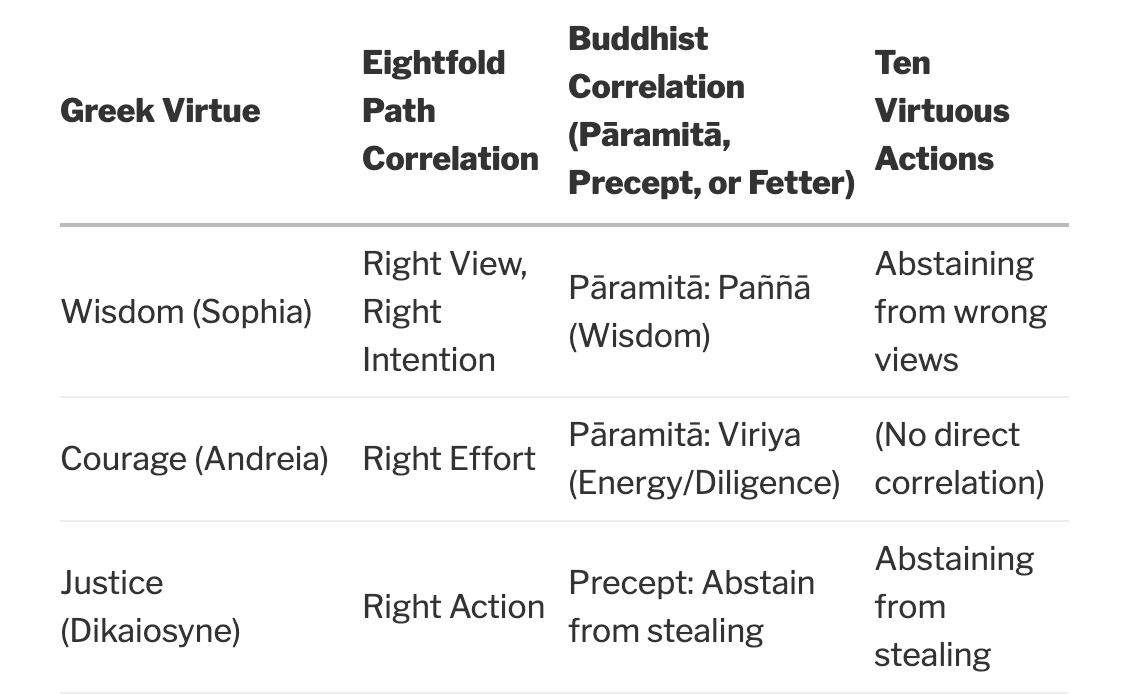
Ancient Greek Virtues and Buddhism
My list of Greek Virtues are a mish-mash of Socrates, Plato and Aristotle. The latter was most interested in the embodied world, the stuff of living so he defined four key virtues: prudence, justice, temperance, and courage – the other rows expand other Virtues that emerged.
Columns 2, 3, 4 are different lenses of looking at (Theravada) Buddhism – these are believed to be closest to what the Buddha said.
Note: this comparison may be utterly silly: Aristotle was seeking to define the characteristics of a good citizen, in stark contrast Buddha’s main project was to end suffering of all sentient beings with enlightenment being the end goal for a person in this life (or at the conclusion). A completely different ambition! In fact, the removal of oneself from society into a monastic life was the recommended path to complete that goal.
That said, much of what the Buddha taught is known by western buddhist practitioners, so the rows/columns are not alien or out-of-bounds for including in a lay practitioner’s life.
The Eightfold Path is the collection of ethical guidance and practices to follow in a path of good living and potentially in preparation towards enlightenment.
A Precept is a rule or commandment to be obeyed by ordained monks and nuns. The Vinaya is the collection of precepts with 227 for monks and (sorry ladies) 311 for nuns. But for my purposes, I focussed on sīla (moral conduct) which is a subset that lay people can practice. Sīla groups 3 important elements of the Eightfold Path right speech, right action, and right livelihood.
A Pāramitā (or Pāramī) can be translated as a “perfection” – in other words a really, really good behaviour or outcome from skillful behaviour. A Fetter is commonly translated as a hindrance, something that gets in your way from progressing the path.
| Greek Virtue | Eightfold Path Correlation | Buddhist Correlation (Pāramitā, Precept, or Fetter) | Ten Virtuous Actions |
|---|---|---|---|
| Wisdom (Sophia) | Right View, Right Intention | Pāramitā: Paññā (Wisdom) | Abstaining from wrong views |
| Courage (Andreia) | Right Effort | Pāramitā: Viriya (Energy/Diligence) | (No direct correlation) |
| Justice (Dikaiosyne) | Right Action | Precept: Abstain from stealing | Abstaining from stealing |
| Moderation (Sophrosyne) | Right Intention | Pāramitā: Nekkhamma (Renunciation) | Abstaining from sexual misconduct |
| Piety (Eusebeia) | Right View | Fetter: Attachment to rites and rituals (overcoming this) | (No direct correlation) |
| Truthfulness (Aletheia) | Right Speech | Pāramitā: Sacca (Truthfulness) | Abstaining from lying |
| Magnificence (Megaloprepeia) | Right Action | Pāramitā: Dāna (Generosity) | (No direct correlation) |
| Magnanimity (Megalopsychia) | Right Intention | Pāramitā: Mettā (Loving-kindness) | Abstaining from ill will |
| Righteousness (Dikaiosyne) | Right Action | Precept: Abstain from killing | Abstaining from killing |
| Friendliness (Philia) | Right Speech, Right Action | Pāramitā: Mettā (Loving-kindness) | Abstaining from harsh speech, divisive speech |
| Wit (Eutrapelia) | (No direct correlation) | (No direct correlation) | (No direct correlation) |
| Conscientiousness | Right Effort, Right Mindfulness | Skillful striving | (Relates to all ten actions) |
| Indignation (Nemesis) | Right Intention | Fetter: Ill will (overcoming this) | Abstaining from ill will |
| Industriousness | Right Effort, Right Livelihood | Ardency | (No direct correlation) |
Additional Ten Virtuous Actions not directly correlated above:
- Abstaining from idle chatter (relates to Right Speech)
- Abstaining from covetousness (relates to Right Intention)
- I think we could relate both of these to the virtue of Piety. (I always have a problem with this word as it seems hijacked by “The Church”TM)
This expanded table shows how the Ten Virtuous Actions align closely with many of the Greek virtues and Buddhist concepts we’ve been discussing. It’s worth noting that some Greek virtues and Buddhist concepts don’t have direct correlations in the Ten Virtuous Actions, as these actions are more focused on specific ethical behaviors rather than broader virtues or spiritual qualities.
The Ten Virtuous Actions provide a practical ethical framework that complements the more philosophical approach of the Greek virtues and the spiritual path outlined in the Eightfold Path and other Buddhist teachings.
The Eightfold Path
I personally think its hard to beat this grouping, so lets flip the table around to see how things correlate to its key guidance.
“Right View” is likely the first and also the last, it relates to the dissolving of Ignorance and it beautifully correlates with Sophia. Once you have “Right View” (usually of the Four Noble Truths) you can really start to prioritize habits in your life that are skillful or not.
| Eightfold Path | Greek Virtue | Buddhist Correlation (Pāramitā, Precept, or Fetter) | Ten Virtuous Actions |
|---|---|---|---|
| Right View | Wisdom (Sophia) | Pāramitā: Paññā (Wisdom) | Abstaining from wrong views |
| Right Intention | Moderation (Sophrosyne), Magnanimity (Megalopsychia) | Pāramitā: Nekkhamma (Renunciation), Mettā (Loving-kindness) | Abstaining from covetousness, Abstaining from ill will |
| Right Speech | Truthfulness (Aletheia), Friendliness (Philia) | Pāramitā: Sacca (Truthfulness) | Abstaining from lying, Abstaining from divisive speech, Abstaining from harsh speech, Abstaining from idle chatter |
| Right Action | Justice (Dikaiosyne), Righteousness (Dikaiosyne) | Precept: Abstain from killing, Abstain from stealing | Abstaining from killing, Abstaining from stealing, Abstaining from sexual misconduct |
| Right Livelihood | Industriousness | Ardency | (No direct correlation, but relates to ethical conduct in one’s profession) |
| Right Effort | Courage (Andreia), Conscientiousness | Pāramitā: Viriya (Energy/Diligence), Skillful striving | (Relates to the effort in maintaining all ten actions) |
| Right Mindfulness | Conscientiousness | Skillful striving | (Relates to awareness in maintaining all ten actions) |
| Right Concentration | (No direct correlation) | (Related to meditation practices) | (No direct correlation, but supports maintaining the actions) |
Additional notes:
- Piety (Eusebeia) doesn’t have a direct correlation in this structure but relates to Right View in overcoming attachment to rites and rituals.
- Magnificence (Megaloprepeia) corresponds to the Pāramitā of Dāna (Generosity), which doesn’t have a direct equivalent in the Eightfold Path or Ten Virtuous Actions.
- Wit (Eutrapelia) doesn’t have direct correlations in the Buddhist frameworks we’re discussing.
- Indignation (Nemesis) is addressed in Buddhism through overcoming ill will, which relates to Right Intention.
This restructured table provides a clear view of how the elements of the Eightfold Path relate to Greek virtues, other Buddhist concepts, and specific ethical actions. It demonstrates the comprehensive nature of the Eightfold Path in addressing various aspects of ethical and spiritual development.
Virtuous Actions
These seem closest to the 10 Commandments (see below): didactic, clear, simple, practical.
| Ten Virtuous Actions | Eightfold Path Correlation | Greek Virtue | Buddhist Correlation (Pāramitā, Precept, or Fetter) |
|---|---|---|---|
| Abstaining from killing | Right Action | Righteousness (Dikaiosyne) | Precept: Abstain from killing |
| Abstaining from stealing | Right Action | Justice (Dikaiosyne) | Precept: Abstain from stealing |
| Abstaining from sexual misconduct | Right Action | Moderation (Sophrosyne) | Precept: Abstain from sexual misconduct |
| Abstaining from lying | Right Speech | Truthfulness (Aletheia) | Pāramitā: Sacca (Truthfulness) |
| Abstaining from divisive speech | Right Speech | Friendliness (Philia) | Pāramitā: Mettā (Loving-kindness) |
| Abstaining from harsh speech | Right Speech | Friendliness (Philia) | Pāramitā: Mettā (Loving-kindness) |
| Abstaining from idle chatter | Right Speech | (No direct correlation) | (Related to mindful speech) |
| Abstaining from covetousness | Right Intention | Moderation (Sophrosyne) | Pāramitā: Nekkhamma (Renunciation) |
| Abstaining from ill will | Right Intention | Magnanimity (Megalopsychia) | Pāramitā: Mettā (Loving-kindness); Fetter: Ill will (overcoming this) |
| Abstaining from wrong views | Right View | Wisdom (Sophia) | Pāramitā: Paññā (Wisdom) |
Outliers
So lets take a look at the outliers, what is uncorrellated?
| System | Uncorrelated or Partially Correlated Elements |
|---|---|
| Greek Virtues | 1. Wit (Eutrapelia) |
| 2. Piety (Eusebeia) – partially correlated | |
| 3. Magnificence (Megaloprepeia) – partially correlated | |
| 4. Courage (Andreia) – partially correlated | |
| Eightfold Path | 1. Right Concentration – partially correlated |
| 2. Right Livelihood – partially correlated | |
| Buddhist Concepts | 1. Pāramitā: Dāna (Generosity) – partially correlated |
| 2. Pāramitā: Khanti (Patience) | |
| 3. Pāramitā: Adhiṭṭhāna (Determination) | |
| 4. Pāramitā: Upekkhā (Equanimity) | |
| Ten Virtuous Actions | (All are correlated to some degree) |
Wit: As a lay person in 21st century, reading the Suttas (or Sutras) its difficult to find evidence of the Buddha cracking jokes, we often see (on Youtube) the Dalai Lama laughing, so I don’t think the religion’s originator lacked a capacity for “Wit”. Its likely that “wit” is just not “Right Speech” because it usually relies on some wordplay that may confuse some people – that would be antithetical to his goal as a teacher. On the other hand, parables were a core part of the teaching and culturally of that time, they may have had some thigh-slapping elements that go over our western modern heads. An example may be: The Buddha often referred to himself as the Tathagata, which can be interpreted in multiple ways. It can mean “one who has thus gone” or “one who has thus come,” creating a deliberate ambiguity that reflects the Buddha’s transcendence of ordinary categories. If that was his intention, it IS pretty metaphysically funny.
The 10 Commandments
Taking a look at Christianity, a pretty clear set of 10 ethics were chipped out on a few Mt Sinai baked boulders – so they were built to last. Ironically some wag soon predicted that the unwashed masses could not cope with a clean 10 and they will require a more complex “10 times 10” and “10 times 10 times 10”, which brings us to today’s society where lawyers are the high priests and get big money for it. (sigh).
| Ten Commandments | Ten Virtuous Actions | Greek Virtues |
|---|---|---|
| 1. You shall have no other gods before Me | Abstaining from wrong views | Wisdom (Sophia) |
| 2. You shall not make for yourself a carved image | (No direct correlation) | (No direct correlation) |
| 3. You shall not take the name of the Lord your God in vain | (No direct correlation) | (No direct correlation) |
| 4. Remember the Sabbath day, to keep it holy | (No direct correlation) | Moderation (Sophrosyne) |
| 5. Honor your father and your mother | (Related to abstaining from harsh speech) | Piety (Eusebeia) |
| 6. You shall not murder | Abstaining from killing | Truthfulness (Aletheia) |
| 7. You shall not commit adultery | Abstaining from sexual misconduct | Magnificence (Megaloprepeia) |
| 8. You shall not steal | Abstaining from stealing | Magnanimity (Megalopsychia) |
| 9. You shall not bear false witness against your neighbor | Abstaining from lying | Friendliness (Philia) |
| 10. You shall not covet | Abstaining from covetousness | Wit (Eutrapelia) |
| (No direct correlation) | Abstaining from divisive speech | (Additional virtues often discussed:) |
| (No direct correlation) | Abstaining from harsh speech | Righteousness |
| (No direct correlation) | Abstaining from idle chatter | Prudence |
| (No direct correlation) | Abstaining from ill will | Industriousness |
Summarising what is not correllated from the 10 commandments:
| System | Uncorrelated or Partially Correlated Elements |
|---|---|
| Ten Commandments | 1. You shall have no other gods before Me |
| 2. You shall not make for yourself a carved image | |
| 3. You shall not take the name of the Lord your God in vain | |
| 4. Remember the Sabbath day, to keep it holy | |
| Ten Virtuous Actions | 1. Abstaining from divisive speech |
| 2. Abstaining from harsh speech | |
| 3. Abstaining from idle chatter | |
| 4. Abstaining from ill will |
Buddhism’s “Right Speech” is such a beautiful guidance because at one level it may be about lying (Commandment #9) but also about the skillful way we should talk to each other: not getting into idle chatter (gossip or gaslighting), not speaking harshly (flaming people on Twitter/X), and possibly the non-positive elements of “Wit” mentioned above.
For the above list of uncorrelated Commandments #1 & #3 are an unfair comparison with (Theravada) Buddhism because gods don’t get much traction and “Me” is antithetical to “anatta” (not self/no-self) even if its a God saying it :).
Carved images is interesting because in Buddhism has a fetter of “Attachment to rites and rituals”, so this is correlated to me.
Regarding the Sabbath, the Buddha wasn’t going to give monks any days off 🙂 for material stuff that is.
For lay people, Sabbath has some correlation outside these lists with Uposatha Days occuring on various stages of the moon’s cycle where spiritual practice or observances are more intense.
Also I think the Pāramitā (part of sīla) called Dāna which is Generosity is very much aligned with Sabbath-like priorities.
KISS (Keep it simple, seeker)
In fact an admirable summary for Buddhist lay practitioners might be adjusted to fit daily life:
- Practicing ethical behavior (Sīla)
- Cultivating generosity (Dāna)
- Developing mindfulness and wisdom through meditation and study
In fact, despite having lots of big lists in this post, Buddhism has a simple traditional grouping of “Three Trainings”:
- Sīla (Virtue or Moral Conduct)
- Samādhi (Concentration or Meditation)
- Paññā (Wisdom)
So its nice to see the Greek Virtue of Wisdom (Sophia) is present, perhaps emerging from skillful, ardent practice.